This week, WYSO is highlighting stories and conversations about climate solutions.
This includes a convent in Trotwood that is working hard to find their own solutions and share them with others.
Jen Morin-Williamson is the Peace, Justice and Ecology Coordinator for Sisters of the Precious Blood. She told WYSO’s Jerry Kenney about some of the solutions they’re working on and why.
This transcript has been lightly edited for length and clarity.
Morin-Williamson: Well, your timing is excellent. I don't know if you knew that or not. Because the sisters, the congregation, was really inspired by Pope Francis in 2015. Actually, May 24 is the day that he released his encyclical called Laudato Si. Basically, it's about care for creation and he says in there that to be fully human, to be full of people of faith, we have to care for a creation. And so we can't be fully a human without caring for creation.
And so he had talked to scientists from around the world, especially at that time, there were people who said, oh, climate change is fake, and so he gathered these scientists together and wrote this document and said, no, it's not. Humans are impacting the environment in a very negative way and accelerating that. And as people of faith, again, we are compelled to do something about that.
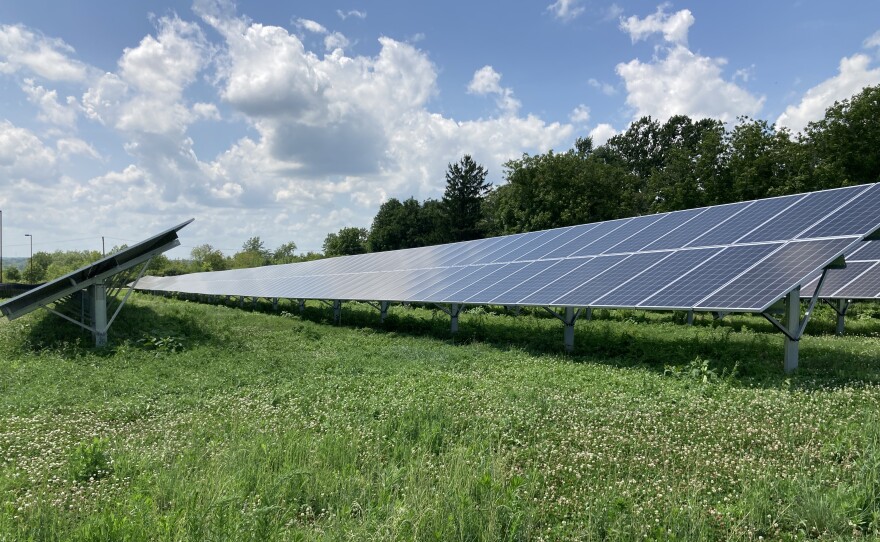
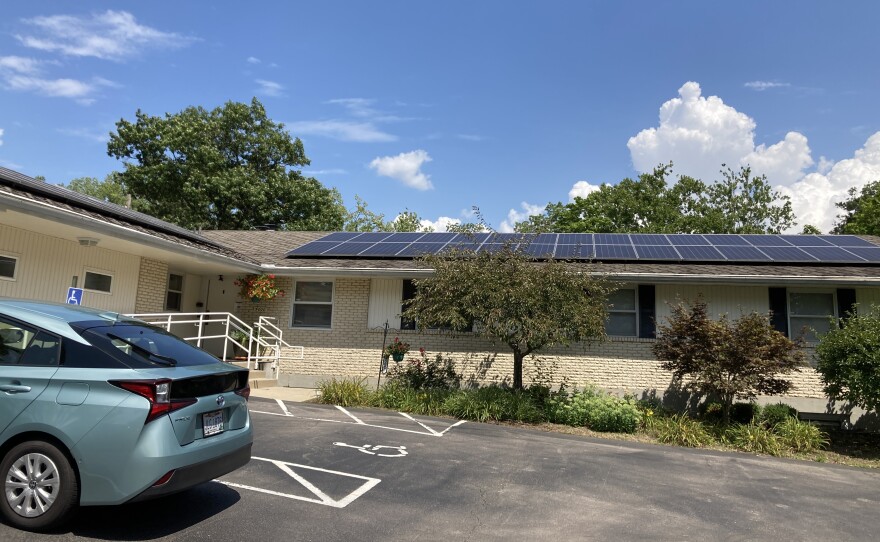
So the sisters took that really, really seriously and started looking into solar. And so at first they tested it on two of their residences here in Trotwood. And that went really, really well. Then in 2018, they decided to do the solar field to provide about 60% of their energy for their retirement home, or as some people might say, their Mother House. So that has been up and running and going great. One of the things as well as caring for creation is underneath the solar fields that they've planted a native prairie. So again, just not just about the energy, it's pretty multifaceted. Like you said, they started doing things with geothermal, changing out all the windows and doors to make them energy-efficient, and then looking at every little thing that they could do.
All their cars are hybrids. I'm working on them getting electric cars. We're not there yet, but I'm working on that.
In 2023, Pope Francis wrote another encyclical, actually another letter, it's called Laudate Deum, saying "hey, as people of faith, you're not paying attention. It's not just climate change, it's a climate crisis now.” And he really called out wealthy countries like the United States and saying what we're doing impacts the climate and it's the poorest of the poor around the world who suffer from that. So what more can we do?
That's about the time I came on working with the Sisters. So working with their legacy of being educators and myself having raised six children. I know how to educate a family is to educate kids, right? So we implemented in several Catholic schools in the Dayton area a thing called the Precious Planet Project. We worked with the schools, their science department, and their religion department for their regular science fair. If they did an environmental project, then we would come and help judge them. And the top project in the eighth grade would receive a $500 scholarship to their school of their choice. So that's been a way, not only now the children learning about Laudato Si, but now they're telling their family about it and they're talking about how it is, again, not just a moral obligation, it's a spiritual obligation.
Kenney: You've got some current projects underway, correct?
Morin-Williamson: Well, most recently, we've been working with Catholic schools in this area as well to compost school waste. In fact, just yesterday I was at one of the local schools and we did a food waste audit in conjunction with the sustainability department at Kettering. Trying to get them to compost their food. One of the things that I found out just blew my mind is that the food that we put in the landfill because it's airtight, basically, it creates methane. The bacteria that breaks it down creates methane. Our Montgomery County Solid Waste District captures about 30% of that. The rest of it goes into the environment to create greenhouse gasses. That is not good, that warms our planet, but if you compost them outside, it's carbon dioxide, it's much better for the environment, and you get dirt right so that's great.
So we're working with these schools help show them how much waste they have. The waste audit we did yesterday, about 87% of the garbage from lunch was either food or liquid so if you can dump the liquid down the drain and if you compost the rest of that? Wow, you're making a lot of big impact on what you're not putting into the landfill.
Kenney: You've got an event called No Plastic July, and I noticed there's a lot of stuff on your website, so you're all very active.
Morin-Williamson: I would love them to look at our website and look at other resources of things you can do. Sometimes it's just the one thing at a time. And it may not feel like a whole lot, but a one thing and you do the next thing and then you build it in. But I would like to say that if people would be interested in being involved in the Care for Creation Task Force, that's part of the Archdiocese of Cincinnati, please, I can get you in touch with those folks.
And again, we were doing this Precious Planet Award, which is a science fair award, and if there are schools that would be interested in participating in that they can reach out to me. And if there are any schools that are thinking, hey, maybe we might be interested in doing composting our food, our lunch waste, our food waste. Again, they could always contact me and I may not be able to do it, but I know a lot of people that might be able to do it.