

After 46 years on the federal bench and 57 years working in law, U.S. District Court Judge Walter Rice has retired.
His last day working full-time in the U.S. District Court was Aug. 28. Rice said after about a week in retirement, he is looking forward to presiding over cases in re-entry court and naturalization ceremonies from time to time after being placed on inactive status.
"I'm still feeling my way, but I want to do as much of that as possible," he said.
Maintaining work in the legal field is something 89-year old Rice does not want to lose. In fact, he said he will also continue to work on mentoring the next generation of judges and lawyers at the University of Dayton.
"I taught there for some 20 years and loved every minute of it," he said. "I may teach again if they ask me, but my two major things would be the Dayton dialog on race relations that sponsors interracial dialogs where we share our experiences, our lifetime experiences. And re-entry, helping people come home, and if they're desirous, turning their lives around."
When asked what advice he would give to a younger version of himself, Rice said he would first remind himself to consider each case as through it were the only one before him and not to talk as much.
"The hardest job I had was the 18 months that I spent in the Dayton Municipal Court, because we would come in on a Monday morning, we had no law clerks, we had no magistrate judges, and we could have 100 to 200 people sitting in a large courtroom," he said. "Most of it was traffic, not all of it, and yet you had to consider each and every case as though it were the only case before you. And that's the best advice I can give a young lawyer."
Rice is also known for his work helping to establish the Montgomery County Office of Re-Entry, which offers programs and services that minimize barriers to re-entry for those formerly incarcerated while "promoting public safety through the restoration of returning citizens."
Rice has been accused of favoring defendants, he said.
"But that is absolutely not true," he said. "If a person can be helped to help himself or herself, adjust to coming home from prison and reintegrating, so to speak, in the community, they become a taxpayer, they become giver to the community."


Years of Service
During his time serving as a judge, Rice has presided over multiple major civil rights, anti-trust, and criminal or drug trafficking cases.
Despite facing many difficult cases, Rice said he would not trade it for the world.
"A criminal case is a human tragedy for not just the person who committed the crime, but the victim and the defendant's family," he said. "And if that person can be helped and at the same time, the community can be protected while that person transforms his or her life, there is no feeling more satisfactory than that."
He said a lot has changed over the decades that he has worked in law. He pointed to race relations, community connections and even the number of cases that go to jury trial.
"Most cases today, both civilly and criminally, are resolved with settlements on the civil side, pleas on the criminal side," he said. "My first several years over here I had 20, 25 jury trials a year. Now we can go an entire year and maybe have one or two. And this is not only a Dayton trend, it's a nationwide trend."
Rice said this shift in the legal system concerns him as he steps away from his work on the federal bench.
“I still think a trial, particularly before a jury, is the best dispute resolution mechanism in the entire world," he said. "And I think a jury trial and a jury verdict helps set the culture, so to speak, of the community in which the case is tried.”
Despite this, Rice is still hopeful for the future of Dayton's courts and legal system.
“I know some of the younger judges over in Common Pleas Court, and they're very, very good," he said. "So, while I have concerns about the legal system, denying access, and the like, I think as far as judging is concerned, the community's in good hands.”
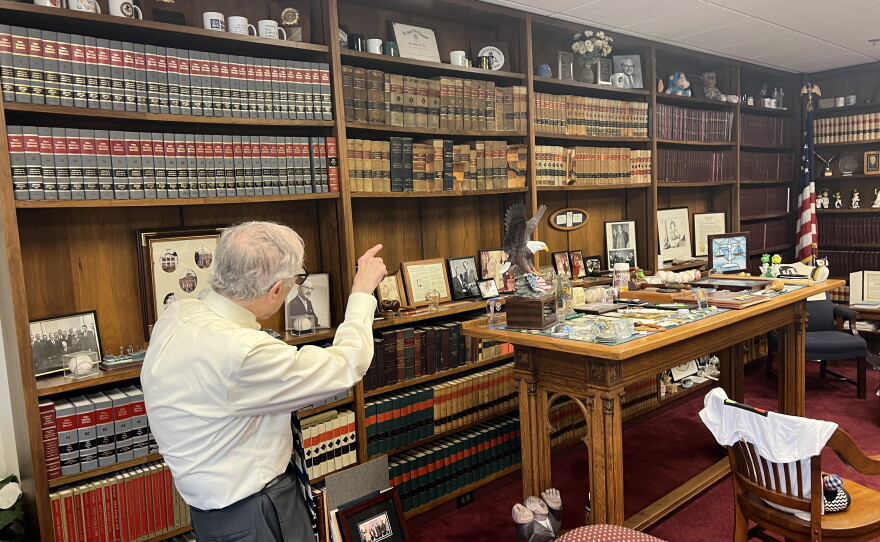
Outside of his lighter legal workload, Rice said he is looking forward to reading some of the books in his collection that he never had time to open before.
"Someone once described retirement as every morning is Saturday morning, which sounds attractive, as far as it goes," he said. "I must have a whole section of a library of books that I haven't read, didn't write any of them, but that I hadn't read. And I want to stay active in the community."
