


Once McCook Field was established as the Army aviation engineering headquarters in 1917, here in Dayton, engineers took on some of the most important challenges facing military flying.
The phrase "faster, higher and farther" gives a pretty good idea of the goals they set for themselves.
- Faster: More powerful engines, streamlined aircraft design, improved fuel.
- Higher: The development of the supercharger, oxygen systems and clothing to survive the frigid realities at great heights.
- Farther: Solving the limits of “how much gas is in the tank.”
The limits of aircraft design and capacity mean you just cannot keep making the gas tank bigger. So the idea of mid-air refueling came along.
Early attempts included a “wing walker” with a 5-gallon gas can strapped to his back. He actually stepped across the open air from a “Lincoln Standard” to a Curtiss “Jenny” and then poured the gas into the tank of the Jenny.
Not exactly a sustainable procedure.
After World War I concluded, the needs of the burgeoning Air Service meant that the engineering division had plenty to work on. The logistics of extending air power included all of the layers involved in faster, higher and farther.
The Army wanted to show its capacity to be a global leader in aviation, and the accomplishments that arose from McCook Field were the proof.
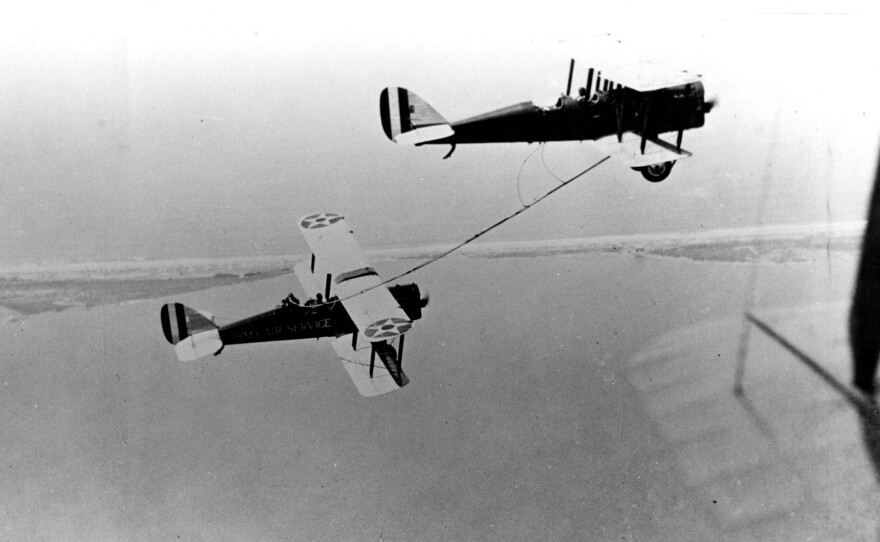
Five years after the war was over, the first true air-to-air refueling mission took place over Rockwell Field in San Diego, California. A pair of DH-4 biplanes made the flight. The two aircraft flew in formation, with one above and ahead of the other.
The lead plane dangled a 50-foot garden hose, which slowly reached the lower plane. Standing in the front cockpit, Lt. John Paul Richter managed to grab the hose, which had been maneuvered to where he could reach the end. He plugged that into the fuel tank and transferred, by gravity, 75 gallons of fuel. Proving that the concept was, in fact possible.
There were a number of laws of physics they were fortunate to have eluded, including the real possibility of a static electricity charge, which could have created a spark. And we all know that you shouldn’t mix gasoline and any kind of spark!
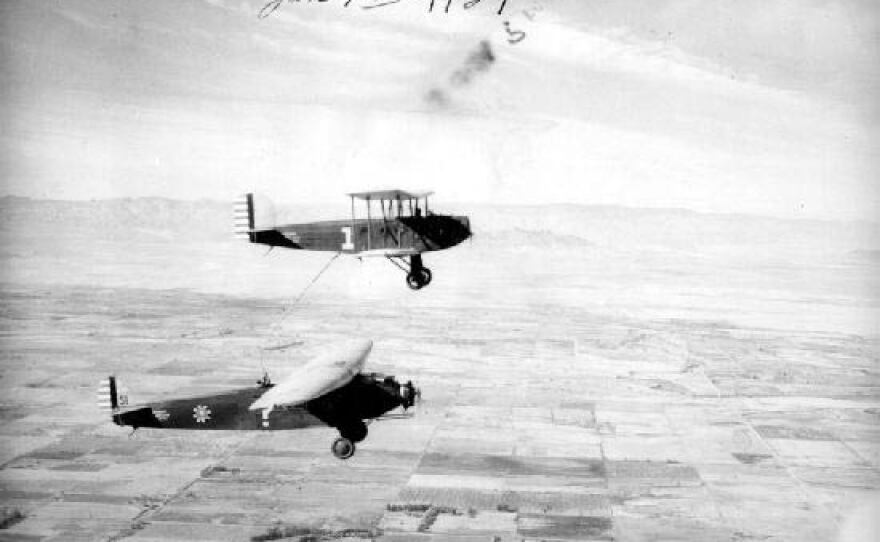
The experiments continued into the 1920s, and perhaps the most visible and public was the flight of the Fokker C-2A named “Question Mark,” as they didn’t know how long they could stay aloft.
Since the aircraft carried only a limited amount of gasoline, in-flight refuelings were accomplished through hoses lowered from two Douglas C-1 aircraft. Oil, food and water were lowered by rope.
After 42 refuelings, including nine at night, one of the Question Mark’s engines failed, which forced the aircraft to land at Metropolitan Airport on Jan. 7. However, the Question Mark’s crew had set the world flight endurance record by staying aloft for 150 hours, 40 minutes and 14 seconds.
None of this should be taken for granted. The amazing skills of military flight crews, who are well trained and practice day and night, have fulfilled the goals set out a century before.
Blue Skies & Tailwinds is sponsored by Sinclair Community College and produced at the Eichelberger Center for Community Voices at WYSO.
