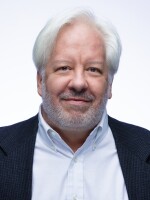
Luke Dennis has served as the executive director of Muse Machine, taught acting to undergraduates, led opera education courses for adults, and served as a curator for Harvard University.
He learned how to make radio documentaries as a member of the first WYSO Community Voices class, was hired at WYSO in 2012 and says he plans to never leave.
In this WYSO Weekend interview, he talked about his family, love for the arts, and the future of the station.
This transcript has been lightly edited for length and clarity.
Kenney: You're listening to WYSO Weekend on 91.3 WYSO. I'm Jerry Kenney, and I'm always very pleased to have an in-studio guest with us, and today it is WYSOs general manager, Luke Dennis. Luke, welcome to the program.
Dennis: Thank you, Jerry.
Kenney: So, I have to tell you, I saw your son in the building recently with you, and I think he's got some height on you now, if I'm not mistaken, or pretty close.
Dennis: He's really close. We compare constantly, and I still am a teeny bit taller than he is, but he's almost, he's gonna certainly exceed me.
Kenney: Okay, how old is he now?
Dennis: He's 16 and you remember when he was a little guy, a very short person.
Kenney: Absolutely.
Dennis: We've marked his height on the wall in the kitchen and we can see like 11 years of his progress in there and he's grown a lot in the last 11 years.
Kenney: Yeah, this wall in the kitchen has a lot of the heights marked of the kids of volunteers, staff that have passed through WYSO over the years.
Dennis: Yeah, we're trying to figure out how to take that wall with us to the new building because it's special. It goes back to, I think we started marking it in 2015 or 2014. So it wasn't right when we moved into this building, but two years after we moved into this building, we started doing that.
Kenney: So the point of these staff and volunteer interviews is to give our listeners a little more information, get to know the people here at WYSO, and let's talk a little bit more about your kids.
Dennis: I'd love to. Okay. I have two kids. I'm so proud of both of them. Lucy is the oldest. She's 19. She is a sophomore at The Ohio State University studying music and education and singing. And Oscar is 16 and he goes to Yellow Springs High School and he just got his first car and I think he's a pretty good driver. And he's a baseball guy, so not a music guy.
Kenney: I do know the arts have always been important to you. We first met when you were the executive director of Muse Machine.
Dennis: Exactly, I used to reach out to you, hoping that WYSO would maybe do a story about the Muse Machine, and that's how we got to know each other, and I still adore that organization, and my heart is very much in arts education and the Dayton arts community. I've, my whole life, been a fan of it, and I've sometimes worked in it professionally.
Kenney: Was Lucy a part of that organization growing up?
Dennis: Yeah, she was. So when she was a little girl, I took her to Muse Machine rehearsals, and she kind of knew what it was. And I always thought, 'Oh, you know, wouldn't it be great someday if she gets to be in one of their shows?' And then when she was a junior and a senior at Stivers School for the Arts, she got leading roles in two different shows that the Muse did, in Little Mermaid, and she played the Dolly Parton role in Nine to Five. And, you know, I'm biased, but I thought she was fabulous. She got to work with Joe Deer so I was just so proud. It was a real full circle moment for me to see her. It had nothing to do with me. I was just in the audience cheering for her. But yeah, my whole family, we love the Muse machine.
Kenney: How many years were you involved with them?
Dennis: About four years, and then moved the family to Massachusetts for a professional opportunity, and then eventually my next job after that was this job at WYSO.
Kenney: Yeah, you started as development director.
Dennis: I did. (former general manager) Neenah Ellis hired me as development director in 2012.
Kenney: And speaking of the arts, you also play music.
Dennis: I do. I have always been in a band, my whole life since I was about 14.
Kenney: WYSO listeners may have heard: you sing the 'sustainer's song' don't you? That we air during fund drive.

Dennis: I do. Yeah, so my friend Mark Babb and I, we used to write a new song for every drive. And that one was just maybe catchy enough — or it was maybe obnoxious enough. It's a banjo and me singing about how sustaining members are like good looking and nice people, and I can't quite remember the lyrics.
But most of what I do is play bass in a band with a couple of guys. We've been a band for 12 or 13 years now.
Kenney: What kind of music?
Dennis: It's all freeform improvised. It's really rooted in jazz and funk. We're only a trio, but we love when a fourth guest might come out and like a flute player, a sax player. We've even had a singer come out and improvise lyrics. So we only improvise now. We actually kind of stopped writing songs and after COVID, we stopped performing out live. So we just play for each other every Friday night.
Kenney: So you don't perform at venues, but it's still a gathering, a small community of musicians that you have.
Dennis: It is, and sometimes our friends come out and sit on the couch. We've got a real man cave thing going with old furniture and a beer refrigerator and yeah, so it's a real joy for me. It's a highlight of my week to make music with these guys there. They've become really great friends and we speak musically together so well
Kenney: The arts is often generational within families. Did you grow up with that? Were your parents into the arts?
Dennis: Yeah, all very much. I mean my dad is such a music guy and when I got into The Breeders and Guided by Voices and Brainiac he did too because he was open to new music, you know in the early '90s when I was in high school, so we always went to concerts together.
We went to a Steve Earle concert together two months ago; like we go to a lot of concerts. My dad's not a musician but my mom is actually a professional musician, a church musician and a piano teacher, and a really terrific pianist. So yeah, I did grow up around music and my parents totally tolerated all the bands that I was in in high school rehearsing in our living room, you know, and all the equipment was in the living room. And so they they've always supported me as a creative person.
"I see news, music, and storytelling being this really powerful mix that we're going to continue to strengthen, and especially within the digital space."
Kenney: Several times we have done, or maybe just once we have the battle of the cats and dogs during the fund drive. Do you have household pets?
Dennis: You're asking me all my favorite topics. Anyone who knows me well knows that I adore my dog Maureen. I talk about her a lot. She's a pit bull rescue and then we have another pit bull rescue that Lucy, our daughter came home from high school with one day because somebody had a pickup truck in the parking lot at Stivers with a bunch of stray dogs that needed a home. We have two dogs and we have a cat named Dill, but always been animal people.
Kenney: You're almost an empty nester?
Dennis: So Lucy's already out, although, being at Ohio State, we see her a lot, which is great, but Oscar is halfway through his junior year, so we're approaching an empty nest and I'm actually not worried about it. Sally, my wife and I, we've been married for 23 years and we actually met in a choir and we've just joined a choir together. So we're already doing stuff together that don't have the kids involved. The other thing in my life in the last couple of months that's become really big is that we joined the Bach Society of Dayton, led by David Crean, who's the music director over at Discover Classical. So it's cool to work with another public radio colleague. I don't know how many voices it is, it's probably 60 or 70 voices, and they bring in a professional orchestra, and they do a lot of classical repertoire. And they also commission new works by young composers, which I think is a terrific ensemble. And we just had our holiday concert over the weekend and I'm super proud of it.
Kenney: You have been with the station, how long have you said?
Dennis: I started here in May of 2012.
Kenney: What do you think about the direction of the station? I know you've been a big supporter of this mix that we've always carried of news and music and storytelling. So what is your philosophy as we continue that mission?
Dennis: I see that they all work in a really beautiful synergy together and that they're all complimentary and they all add up to a total service that has something for everyone. I really believe that. And if you only want to enjoy the news or if you only want to enjoy the music, that works too. But I see our future as continuing to strengthen all three of those areas as well as the area of archives and preservation, which is a pillar of our public service. And I started talking about this in the last couple of months and I like it, so I'm gonna try it out here. I see WYSO as kind of the media arm of the nonprofit sector in the community because it's a place where you can, if you're a local artist or a musician, you'll find a platform here, you'll find support. We care very much about telling the stories of the non-profit sector in Dayton to help them do their work, to raise awareness about social issues or things that they're tackling, food insecurity, environment, some of the beats that we cover here align with the work of good nonprofits in our community. So proud of that.
You and I've been here a long time. You've been longer than I have, and a lot has changed but music has always been a core piece of our public service. I think what you're hearing more and more is that we're putting more and more resources and energy into music, and we're reminding everybody that we see it as just as valuable as our news, that music can be a public service and creative expression that speaks to the heart and not just the mind is really valuable too. So then the same with storytelling. Sometimes facts don't lodge in the brain or the heart the same way that a story does that exemplifies or embodies a set of facts.
I see news, music, and storytelling being this really powerful mix that we're going to continue to strengthen, and especially within the digital space.
We're not going to go anywhere. We're going to always have our FM signal. We'll always be free and available to anyone who owns a radio. But I see a lot of really good creative work happening in both content creation and the ways that we deliver content through the digital space. And I see that through the leadership of Juliet Fromholt with Novophonic. I see that as Will Davis and Chris Welter create new web build-outs for the amazing stories that come out of the center. So I think the future of WYSO is not just one piece of anything.
Richard Wagner would have called it Gesamtkunstwerk, which is the total art form. When you listen to public radio, you get the total form. You get a little bit of everything.
As I look to the future, I see a very bright future for WYSO, even in spite of this kind of scary, precarious situation that we are emerging out of now, where the federal funds were rescinded six months ago. The local community has stepped up in a big way. We continue to hit our revenue targets every month, and what the community doesn't know yet or hasn't really seen at all is that we're moving into a gorgeous new facility in the February, March timeframe that's gonna exponentially expand our ability to serve the community, to bring the community together and to do creative programming within the arts and within storytelling and music. So all of that adds up to a really bright future for the station.