Wait Wait... Don't Tell Me! is NPR's weekly hour-long quiz program. Each week on the radio you can test your knowledge against some of the best and brightest in the news and entertainment world while figuring out what's real news and what's made up.
On Sept. 3, it's your chance to see the show live in the Dayton area for the first time in nearly a decade.
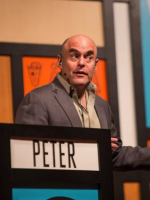
"Wait Wait ... Don't Tell Me!" Host Peter Sagal spoke with WYSO's Jerry Kenney about their upcoming show at The Rose Music Center on Sept, 3, 2026.
Tickets for the show are available online.
Kenney: Peter, thanks for doing this. It's a real honor to speak with you. You are coming to Dayton for what, like the fourth time?
Sagal: Yeah, but not for a while. I think the last time, if I remember correctly, was something like six or seven years ago, if I’m not mistaken. But weirdly and quite happily, as far as I remember, some of our very first shows on the road, which way back when were the only shows we did in front of a live audience, were in the Dayton area. We came a bunch of times. Partially because our producer at the time, who tragically passed away this spring, was an Ohio native and he loved to go home. So some of our very first and happiest experiences in front of a live audience were in the Dayton area.
Kenney: And what prompted the decision to take the show on the road?
Sagal: Well, it's a slightly complicated story, but also kind of a simple one. The complicated version is that our show was designed by our creator, Doug Berman, the same guy who gave the world Car Talk, working with NPR, to be a studio show. And it had a lot of reasons why that was such a good idea.
"Nobody quite knows what's ever going to happen when we start our show, even though we have a plan."
One was you have a national talent pool, you don't have to fly anybody in, you just put them in studios, connect the studios. Secondly, the sound quality was such that you can edit it, which is a big thing with Mr. Berman. He likes to edit things to make them sound as good as possible. The studio makes that a lot easier. And so that's how the show was set up. But here's the simple reason why we moved to a live format eventually, or rather I should say, in front of a live audience. If you have an audience for a comedy show, they might laugh, which is good. Sounds good and it incentivizes the performers to be funnier because people might laugh, you know, it's like dolphin and herring. And the way it happened was purely, well I'd say by accident, but it was more like somebody else had the idea. We got a call from a guy who ran a station in Salt Lake City, not the major station there, a smaller one that is now no longer, saying, look. We think it'd be really fun to have you do our show for us in front of an audience that we'll provide. We'll give you everything. We'll get you hotels; we'll get your airplane tickets. We'll set it up for you. Just come on out and do it for us. And we were like, okay, seems easy. So we did it. And that was in January of 2000, just about two years almost exactly since the show premiered on the air. And it was like this amazing success.
Remember what I said about people laughing? And so as soon as that was broadcast, every other station, including WYSO in Dayton, started getting in touch and saying like, oh, would you come and do it for us? And so we started doing these shows on the road every month eventually. And it was just so obvious, the show was so much better in front of a live audience, which by the way, seems obvious in retrospect that in 2004, we started moving to all live audience taping. And that's what we've been doing ever since.
Kenney: You have normally done indoor venues, I think, but more recently outdoor venues?
Sagal: We've done both. One of the things about my life that makes me think that I'm just in the middle of some sort of weird dream that I will eventually wake up from is that our show and me and my colleagues and friends have played some of the premier outdoor music venues in America, including Tanglewood and Wolf Trap in Virginia, near Washington, and most surreally, and I use that word advisedly, Red Rocks. We played Red Rock, you know, me, Bono in the Rain. The big signs of, you know, the big iconic images of Red Rocks. We've also played one big outdoor venue up near Cleveland, I think, called Blossom, the Blossom Music Center. And so this is this is not entirely new for us. We just, in fact, played an outdoor venue in Sonoma, California, the Green Music Center, and it’s great fun. I love it. The weathers nice. People bring picnics and there's nothing, you know we don't have like two drink minimums in public radio, but if people bring nice bottles of an inexpensive but charming Chardonnay that has the same effect, and the audience is even that much more receptive to what we're doing.
Kenney: Well, the Wait Wait crew is going to be live at Rose Music Center on Sept. 3. It's a great outdoor venue. We'll hopefully have plenty of people there. Let's talk a little bit about the format of the show. There's a lot of serious news happening in the world.
Sagal: Isn't there a head notice?
Kenney: Yeah. Why do you think it's important to present it, some of it in a funny, not so serious way?
Sagal: The best way to answer it is, is I don't know if I'd be able to have gotten through the last — oh, I don't know — decade or so with my sanity intact if I wasn't able to do the radio show and make dumb jokes about the dumb aspects of the week's news.
So speaking for myself, it's been an essential survival tool, but I imagine it has some of that same effect for the listeners, or that's what they tell me. I mean, I think we're all... You know, we're all public radio people here, right? I'm a public radio person; you're a public radio person. Everybody listening to us right now is a public radio person and when we take things seriously, we public radio people, we listen to the news, we make sure that we're informed. Sometimes it feels like a serious civic duty to be informed and listen to our, you know, public radio stations and my colleagues at NPR News. And so we just need a break, don't you think? Once in a while, maybe an hour a week to get goofy and stupid and make dad jokes and poop jokes, say rude things about important people, just to let off some steam or provide a distraction.
It's been my lifeline in an otherwise sometimes very bleak news environment, so I assume it provides that for the audience as well.
Kenney: On Sept. 3, the audience will get a chance to see really what happens behind the scenes before the fully produced show is released. And can you, I know they're going to see it for themselves, but can you describe a little bit of how it goes?
Sagal: Well, our show, I mean, again, two ways of looking at it. One way is it's pretty much our show that you hear on the radio. We record our show live to tape. It's not like we're doing anything weird, you know, some strange, you know, guess the picture segment that only the live audience can see. But on the other hand, we routinely record at least 90 minutes material that gets edited down to the about 52 minutes of radio show or podcast that people hear. So that's... slightly less than twice as much material and a lot of that material is great but we just can't broadcast it partially because we don't have room sometimes because if we did broadcast it we'd all be arrested uh that used to be a joke I don't know if it is anymore. Uh, there's a lot of stuff that happens on stage that we never anticipate um and is amazing and surprising, and only our audience who have come to see us live will ever know about.
For example, I just mentioned we did a show in Sonoma, California. One of our panelists talked about a sideline she had, a little bit of extra work. Well, perfectly legal, I should say. Uh ... I can't tell you about it because we're on the radio now. So the reason that we couldn't broadcast it on our radio show is the same reason I can tell you it now. And only the people who came to see us in Sonoma a couple of weeks ago will ever know about that. It'll be something they'll carry with them for the rest of their lives.
I guarantee you there must be one person who was there who might be listening to this and they are laughing their heads off right now because it was amazing.
One thing people may or may not know about our show is although we have a very wonderful writing staff who I work with every week to come up with stories to talk about and jokes to make about those stories and all kinds of other things. Our show is still very much improvisational. Our panelists, for the most part, have no idea what we're going to ask them. I have no what they're going to say. Certainly that's true of our special guest as well. And so, nobody quite knows what's ever going to happen when we start our show, even though we have a plan. Part of our intent is for that to go off the rails. And it always does. And so coming to see us is one way to find out what really happens when there is no editor involved.
Kenney: Let's jump back for a bit if you don't mind and tell us how you got involved with the program.
Sagal: Dumb luck, absolutely dumb luck. I do not deserve it in any way. I'm just, if people were to take my career as an example of how to proceed, basically you do something else for a long time and then one day the phone would ring, and someone would pretty much just offer you your dream job out of nowhere and then you'd have it. Which is not too much of an exaggeration. I did mention that the show was invented, created by Doug Berman, famous for Car Talk and other things, who NPR hired to create this new comedy show, this comedy news quiz for NPR, now going back on 30 years ago. And he put the show together. It was not me. People say, oh, is this something you always wanted to do? And I used to lie and say, yeah, I was always a quiz guy, you know. I created my own major in college quiz show studies. No, I just was this guy. I was a writer writing plays and screenplays when I got a phone call from somebody, I knew saying, hey, would you like to be a part of this new show on NPR? I think you'd be good for it. Okay, great. So I put my name in, I got the call, I auditioned on the phone, I was a panelist on this brand-new show that broadcast, that first broadcast in January of 1998 called Wait, Wait, Don't Tell Me. It was, shall we say, a work in progress, I think, to be polite. And one of the things that Doug and his collaborators at the time decided they needed to do to make progress was to find a new host. So with time pressure, extraordinarily, and pressure from the stations, people may or may not know this, but every station in the public radio system, WYSO, everyone else, makes their own decisions about what they're going to broadcast in any given moment of the day. NPR doesn't say, okay, now everybody has to broadcast this, and everybody says yes or no. It's all independent. It's individual decisions. And some stations had chosen independently to broadcast his new show. Their audiences weren't thrilled. They weren't thrilled. They felt like they had put themselves out there to bring this new show to their audiences.
They needed something to happen quick all which means that with no other options immediately available and no time to find new ones they turned to me and asked me to be the host and I was like sure I could host a public radio show how hard could that be? Geez, I mean, I hear these people do it all the time, so I moved to Chicago to become the host in May 1998, thinking that'll be fun for a few years before I move on to my next, you know, whatever. And here I am, almost 30 years later talking to you about it.
Kenney: And you've been able to work with some great co-hosts, scorekeepers, judges, and panelists, Carl Castle. I bet there are still answering machines out there with Carl's voice on them.
Sagal: I hear from people every now and then they say, I want you to know I have Carl's voice in my answering machine or voicemail or whatever it may be.
"The reason the show is interesting is because whenever I am on stage — as I will be at The Rose — and look to my left, stage left, I see three delightful people who are funnier and more talented and more entertaining than I'll ever be."
We go back so long, we actually used to send out cassette tapes, ladies and gentlemen. That's how old we are, which people still have. I don't know how they play them. No wax cylinders, as far as I know. And all I want to do when people tell me that is call them so I can hear Carl's Voice. In fact, we've been doing this thing for... NPR Plus, people who donate a little extra get access to audio and material and fun extra things. And one of them is a game where we go back and we ask a new person questions that we asked a listener contestant 20 years ago. And I get to hear Carl's voice and I miss him. He was wonderful. I've gotten to work now with three amazing judges and scorekeepers. Again, never saw that coming, but here we are.
Kenney: Yeah, you're working with Alzo Slade?
Sagal: Alzo Slade, who just took over.
Bill Curtis our second amazing judge and scorekeeper retired from the post at the end of May and Alzo Slade, the newest, took over in the beginning of June and he's great.
It's funny though when we welcomed Alzo at a private event and I said this is going to be so weird. It's going to be so strange after so many years to be doing the show without an elderly white man on stage and everybody looked at me and I was like, oh so at least we're continuing that tradition one way or another.
Kenney: Any insights looking back over the 30 years about the evolution of the program?
Sagal: The show has in many ways stayed the same. The elements of the show first what was once Who's Carl this time is now Who's Alzo this time. The Listener Limerick Challenge invented by a producer named Leslie Fuller way back in '98 still there and so that's the same and I think that's good people love in radio in particular they love stability they love predictability they want to hear the things that we normally do the things that they've been tuned in and just like they used to tune in to Car Talk, to hear them talk about cars. If they started talking about elephants, it wouldn't have been the same show.
But the way that we've changed — and I say this in all humility — because I have depended on it, is we have refreshed and improved and renewed our cast of characters. And I mean that both onstage, our panelists, and backstage. I work with an array of wonderful people. Just about all of whom are younger than I am, all of them are funnier than I'm, and many of whom have perspectives and opinions and ideas that I just don't have. And if this show, God forbid, relied just on what I, Peter Sagal, had to say about anything, it would have faded into oblivion, deservedly so, decades ago. The reason the show is interesting is because whenever I am on stage — as I will be at The Rose — and look to my left, stage left, I see three delightful people who are funnier and more talented and more entertaining than I'll ever be. And now when I look to right, I see Alzo Slade, who is all of those things and more. And that's, to me, what keeps the show, basically, I'm the ringmaster, and if you want to ask why the circus has been going on so long, it's because the acts are so good. I'm just the guy pointing at them.
Kenney: The acts are great, but you do a great job of playing off the fine senses of humor that are collected on stage.
Sagal: Yeah, yeah, I mean, you know, that, if I have any skill, as I tell people sometimes, if they're going to come in and be a guest host when I take a week off, what I tell them, and a lot of times there are panelists and the job is different, and what I say to them is, when you're a panelist, somebody like, say, Nagin Fursad, I say, when you are a panelists, Nagin, your job is to be funny. When you're the host, your job's different. Your job is to make funny happen, and that means tossing a softball to one of the panelists. That means asking a question to which the answer is going to be hilarious, even if the question wasn't. It means if somebody says something interesting, instead of trying to top it, you say, well, tell me more about that, or words to that effect, so that they become even more interesting and funny. And, you know, that's something I've done for a very long time, so I'll cop to being pretty good at that. But like I said, if I didn't have the collaborators and friends that I have to do the show with, I would be a very small footnote in now the increasingly distant history of public radio.
Kenney: I collected some questions from my fellow coworkers here at the station and I'll leave you with the final one. Someone wanted to know what you actually thought about Dayton.
Sagal: Oh, I love Dayton. I think Dayton's a beautiful town. I mean, I think, you know, I'm there with Randy Newman. I think it's a great, great place. And one of the things that I have loved about doing my show is that we've traveled all over the country, literally, from Seattle to Miami, from San Diego to Maine, and everywhere in between. And one the things I have loved over the almost 30 years is to see how many places, which were once, and I use this term advisedly, please don't get upset with me, backwaters, have... been revived and have found new life, in many ways a restoration of what they once were.
As young people either come home or seek places that are more affordable as people decide that there's no reason why some big city somewhere should have x or y or z, and not their town, why people have taken pride. So I'll give you a — if not a Dayton specific — an Ohio specific example of what I mean. Of all the theaters that I have ever played, and I've played in many of them, I mentioned some of them, the most beautiful, without doubt is the Akron Civic Theater. Akron, Ohio, right? Of all places. And if you've been to this place, you'll know what I mean.
Akron like Dayton, like many other cities when it was founded and in the early 20th century saw itself as a regional capital, a place where amazing things would happen. And in the... mid-to-late 20th century as urban fortunes declined, and all kinds of other things happened. I'm not qualified to really talk about. These cities declined, people fled. Sometimes the infrastructure, the urban core was hollowed out. But what's happened, as with the Akron Civic Theater, which was built by the city fathers of Akron when it was the rubber capital of the world, when there was money and attention. They said, we're going to do something amazing for our town, we're going to build this beautiful theater which you know at the time was what you did if you were a serious community and in a cultural capital and what's happened of course, it fell into decline like everything else and then it’s come back. People have rebuilt this theater and restored it to its glory.
And I'm seeing that everywhere I go, that places that maybe my generation born in the '60s would have seen as being just like gone, rusted out, the Rust Belt, are now vibrant and fun and exciting and filled with people who love it and who put the effort and time to make it a wonderful place to live and I enjoy it every single time. Every single time I get to go someplace new and feel the vibrancy and the life that has either returned to it or in some cases never left and it's just great. So it’s really fun.
Kenney: I think you've wonderfully described what is taking place here in Dayton and the resurgence in some of the local communities as well. So I thank you for pointing that out. And you're very lucky to actually get a firsthand view of that over the last 30 years. And we're lucky to have you coming back to the Rose Music Center on Sept. 3, the entire cast of Wait, Wait ... Don't Tell Me! And you can find out the information on our website. Peter Sagal, it has been a pleasure to speak with you.
Sagal: That's my pleasure. And I'm looking forward to seeing everybody who's listening. And if you think I'm talking about you, I am I mean you specifically, I'm not going to name you because I don't want to make you get any awkward questions about how we know each other. But yes, I am very much looking forward to seeing you specifically at The Rose. So please come on out.
Kenney: Thank you so much. We can't wait to see you.
Sagal: Thank you so much.