

Recently, protests against federal immigration policy have broken out at high schools across the nation, revealing teenagers who are more politically engaged than many might have imagined. These protests, organized on social media, powered by content creators and streamed live to the world show no shortage of ways high school students have found to speak out.
But in the politically turbulent Vietnam War era, high schoolers had far fewer ways to get their opinions out and lacked the freedom of speech with which to do it. High school newspapers were common, but the level of censorship and control exerted by schools was vastly different than today.
Students rebelled by printing their own underground newspapers.
Historian Aaron Fountain sheds light on these mostly forgotten papers in his 2025 book, “High School Students Unite!” Fountain who's based in Indiana, previously lived and worked in Northeast Ohio, serving as historian on the Cleveland Civil Rights Trail project.
“An underground newspaper is pretty much an unauthorized or an uncensored publication, produced by students off campus but distributed on campus and when it came on campus they would get suspended or expelled,” Fountain said.
The primary reason that underground high school newspapers started to multiply furiously in the late 1960s was the improvements in offset printing technology that made creating an underground newspaper economically feasible.
Fighting to speak out
Among the high school students across the country bristling at the lack of free speech on the issues of the day was Lauren Baker. Baker, now a retiree living in Milwaukee, was a student at Orange High School. She wrote for their underground newspaper, “The Hunter.”
“You know, it might be about the war in Vietnam or about civil rights or, you know, the world was, um, exploding in a very positive way,” Baker said. “So the idea that you could actually get opportunities for women and for people of color and you could end unjust wars. All of those things we totally believed and fought for.”


The topics covered by underground newspapers ran the gamut, from issues of world significance to more local activism. Students from minority groups often fought for more representation.
“There's demands for like more Black teachers and Black history courses being studied and being taught. Same thing with Mexican American, Asian American students,” Fountain said.
At Orange High School, Baker said she and other students were fighting for equality in the dress code.
“So like at my high school, my freshman year, we broke the dress code because they still, you know, in freezing cold, snowy Cleveland, you know they still didn't let girls wear slacks to school and boys had to have their hair really short,” she said.

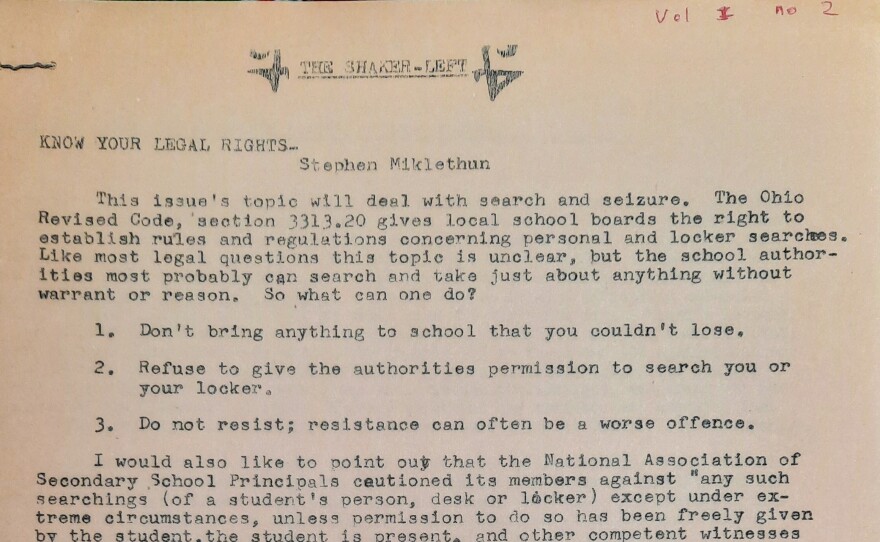
Underground papers featured comic strips, unvarnished editorials and a general tone that was rebellious in nature and unafraid to break the rules of journalism. They included serious attempts to change school policy, politically charged art and musings about the world.
Some underground high school newspapers were organized and inspired, to the point where there was even a short-lived press syndicate that linked over 700 of these newspapers across the country.
“Underground newspapers, for the most part, they might come for one issue, two issues, and most disappeared. Some were much more ambitious. They would have field correspondents that would travel to different schools around a city to report on protests,” Fountain said.
Part of the reason these papers were so good at mimicking the process of traditional journalism was that staff at the underground newspapers were often also writers for sanctioned high school papers, according to Fountain.
Underground papers were independent creations, but they didn’t exist in a vacuum.
“A lot of underground newspapers high school underground press is largely in response to censorship So they often would like play on the names of the main school newspaper,” Fountain said.
At Shaker Heights High School, for instance, the underground paper was called “The Shaker-left”, a play on the long-running student newspaper, “The Shakerite.”
There were risks for students beyond the potential for punishment from their schools when it came to writing for these underground papers. Some had to also keep their activism hidden from their parents. Fountain documented one instance where a father found a newspaper in their son's backpack and reported it to the FBI.
But others got encouragement from parents who understood their cause. In Orange, Lauren Baker said her mother, an ACLU advocate, actually hosted an after-school radio show on WMMS that would bring students on the air to talk about issues facing them in schools.
Short run, lasting significance
By the mid 1970s, the underground high school newspaper scene was mostly dead.
Northeast Ohio remains a place where students make their voices heard. Baker, for one, is pleased to see student activism thriving.
“I don't see underground newspapers anymore, but on the other hand, I see kids running school newspapers. And I also see teachers interested in giving those kids voices, which they were maybe more afraid of doing back in my day,” Baker said.
